
Umi Cahyaningsih1 , Yulia Yellita2 , Eliyus Putra3 , Roza3 , Fadjar Satrija1 , Ridi Arif1 , Dwi Inarsih3 , Budi Santosa3 , Arifin Budiman Nugraha1,*
Abstract
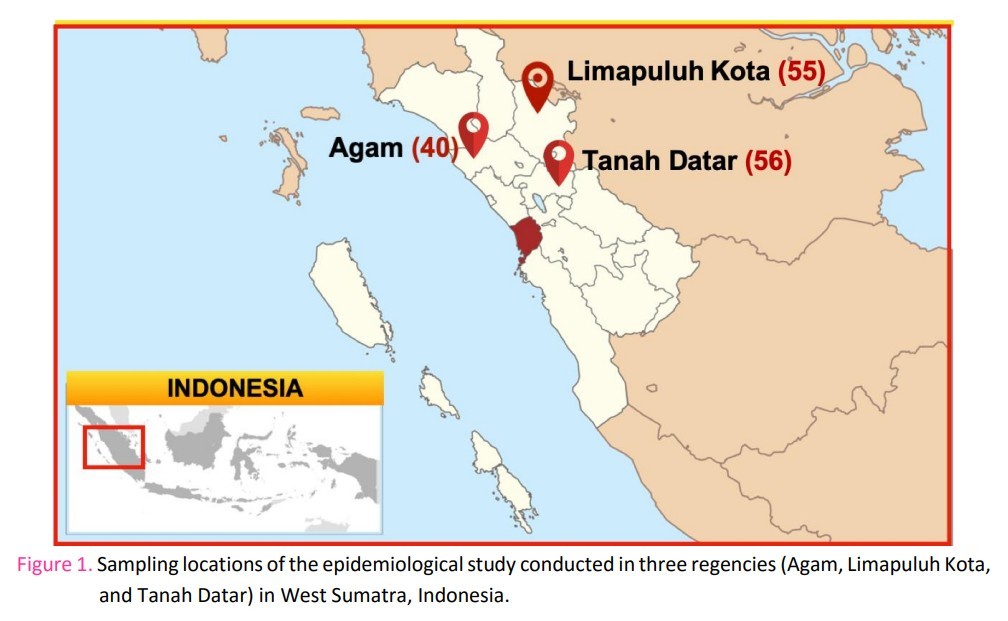
This epidemiological investigation conducted in three regencies of West Sumatra, Indonesia, aimed to examine the molecular prevalence and distribution of Babesia bigemina, Babesia bovis, and Theileria orientalis. A cross-sectional study employing a convenience sampling technique included 151 cattle blood samples. These samples were collected from three regencies (Agam, Limapuluh Kota, and Tanah Datar) between January 2023 and February 2024. Blood samples were examined using polymerase chain reaction (PCR) coupled with sequencing, targeting the cytochrome b gene for B. bigemina and B. bovis, and the 18S rRNA gene for Theileria spp. A total of 151 cattle blood samples from West Sumatra were examined for hemoprotozoan infections using both microscopic and molecular approaches. Based on blood smear examination, 23 (15.2%) and 118 (78.1%) samples were positive for Babesia spp. and Theileria spp., respectively. Subsequent nested PCR analysis confirmed all Babesia-positive samples as B. bigemina, while B. bovis was not detected. In contrast, 131 (86.7%) samples were molecularly identified as T. orientalis. Phylogenetic analysis of the cytochrome b gene revealed three distinct clades of B. bigemina, indicating genetic diversity likely shaped by geographical distribution, vector ecology, or host adaptation. These findings demonstrate that T. orientalis is the predominant hemoprotozoan agent in West Sumatra, while the genetic variability of B. bigemina underscores the complexity of its epidemiology. Together, these results provide critical insights for improving surveillance and guiding the formulation of effective hemoparasite management strategies in the tropical Indonesian archipelago.
Keywords: Babesia bigemina, Babesia bovis, Theileria orientalis, West Sumatra
Artikel bisa diakses di: https://e-journal.unair.ac.id/JMV/article/view/77394